
Analyze Klaviyo email performance in Email Donut
Use the Email Campaigns report to compare revenue, engagement, reach, and individual campaign performance.
Use the Email Campaigns report when you want to understand what changed in your Klaviyo program, identify campaigns worth repeating, and turn performance evidence into the next calendar or creative brief.
Before you start
- Connect the correct Klaviyo account to the Email Donut brand.
- Wait until the Klaviyo settings page shows the connection as ready or the report says data is available.
- Confirm that Email Donut selected the revenue metric your team uses for campaign reporting.
1. Open the Email Campaigns report
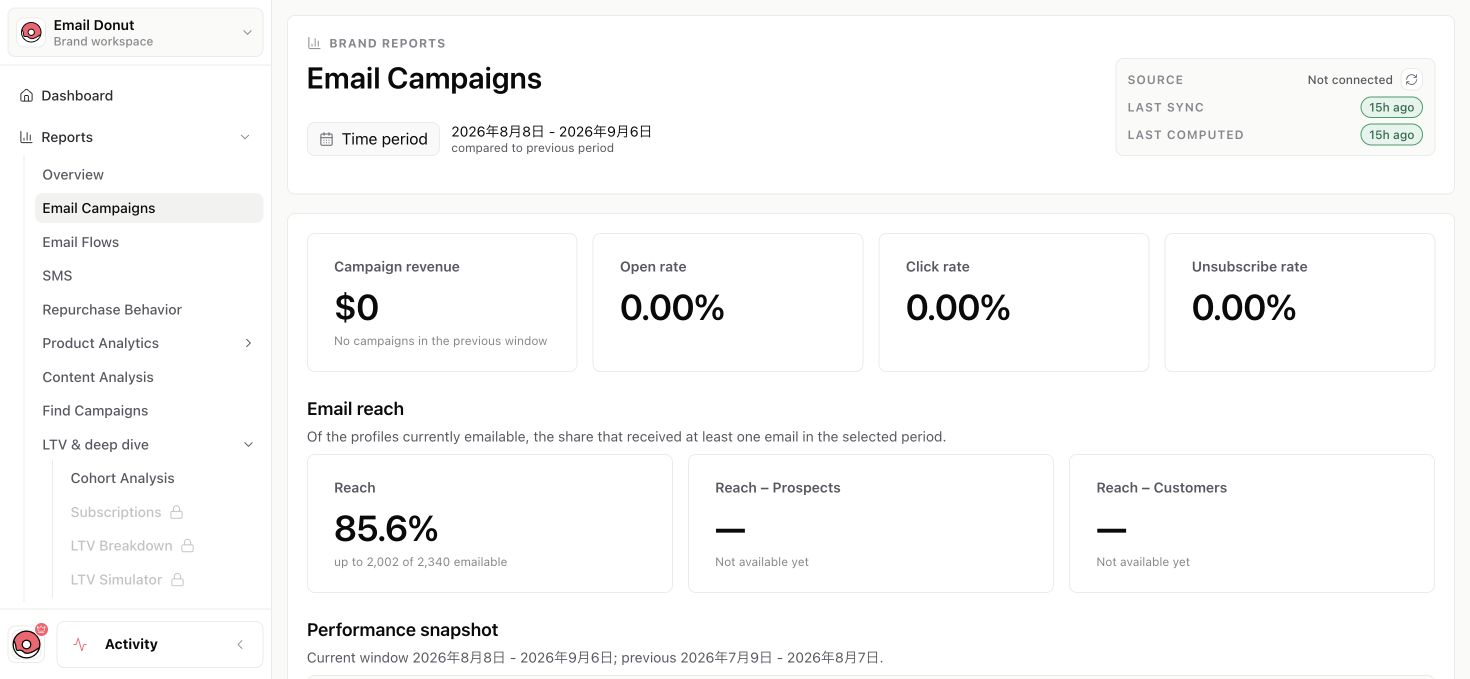
Open the brand workspace, choose Reports, and select Email Campaigns. The report uses synchronized Klaviyo campaign and event data for the selected brand.
2. Choose the analysis window
Use the date control at the top of the report to choose the period you want to study. Start with the last 30 days for a current operating review, then widen the range when campaign volume is low or you are looking for seasonal patterns.
Choose a comparison that matches the question:
- Previous period — Compare the selected range with the immediately preceding range. Use this for week-over-week or month-over-month operating reviews.
- Previous year — Compare with the matching period one year earlier. Use this when seasonality has a strong effect.
- Custom — Choose an exact comparison window, such as a launch period or promotion from a different date.
3. Read the primary scorecards
Start with the top-level campaign scorecards:
- Campaign revenue — Revenue attributed to email campaigns in the selected window.
- Open rate — The share of delivered messages that Klaviyo recorded as opened.
- Click rate — The share of delivered messages that generated a click.
- Unsubscribe rate — The share of recipients who unsubscribed after receiving campaign email.
Read the current value together with its comparison. A higher revenue result with flat reach may point to stronger merchandising or targeting. Higher reach with weaker click rate may indicate that the campaign reached more people without matching their interests.
4. Check Email Reach
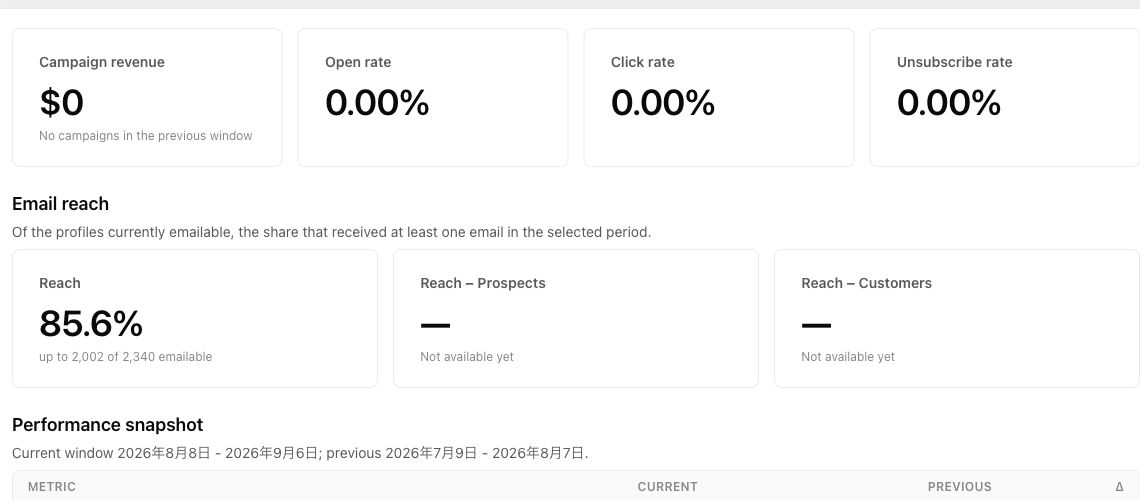
Email Reach shows the share of profiles currently emailable that received at least one email during the selected period. Use it to distinguish an engagement problem from a coverage problem.
- Low reach with healthy campaign engagement suggests that more of the emailable audience could be contacted.
- High reach with falling engagement suggests that cadence, relevance, or creative may need attention.
- A permission warning for segments means the Klaviyo connection needs segments:write before Email Donut can calculate exact reach with managed segments.
Reach snapshots are prepared in the background. A newly connected account may need to complete a scheduled snapshot before every reach value is available.
5. Compare the performance snapshot
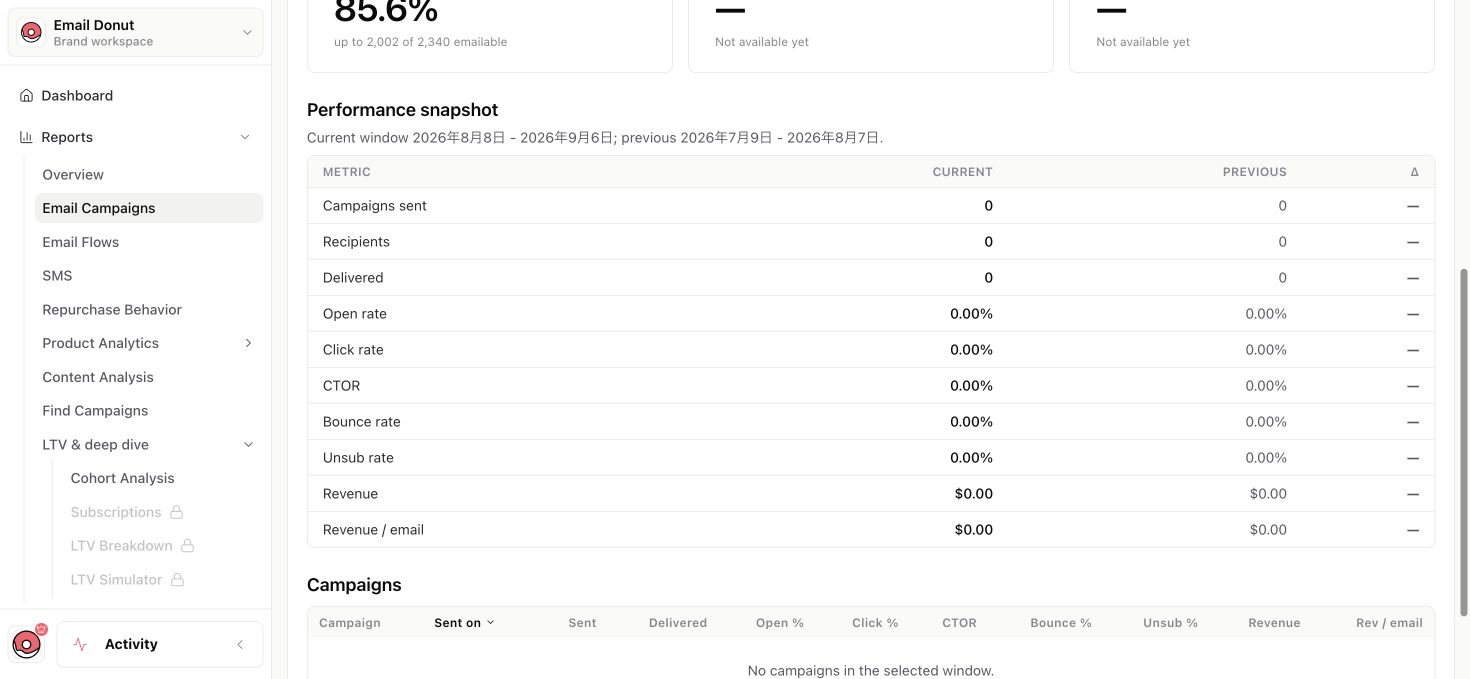
The performance snapshot places the current and comparison windows together. Use it to verify whether a scorecard change is broad or driven by one unusual campaign.
Review revenue and engagement as a group. For example, rising opens with falling clicks can mean the subject line improved while the email body or offer became less persuasive.
6. Find the campaigns behind the result
Use the campaigns table to move from account-level change to specific sends. Look for:
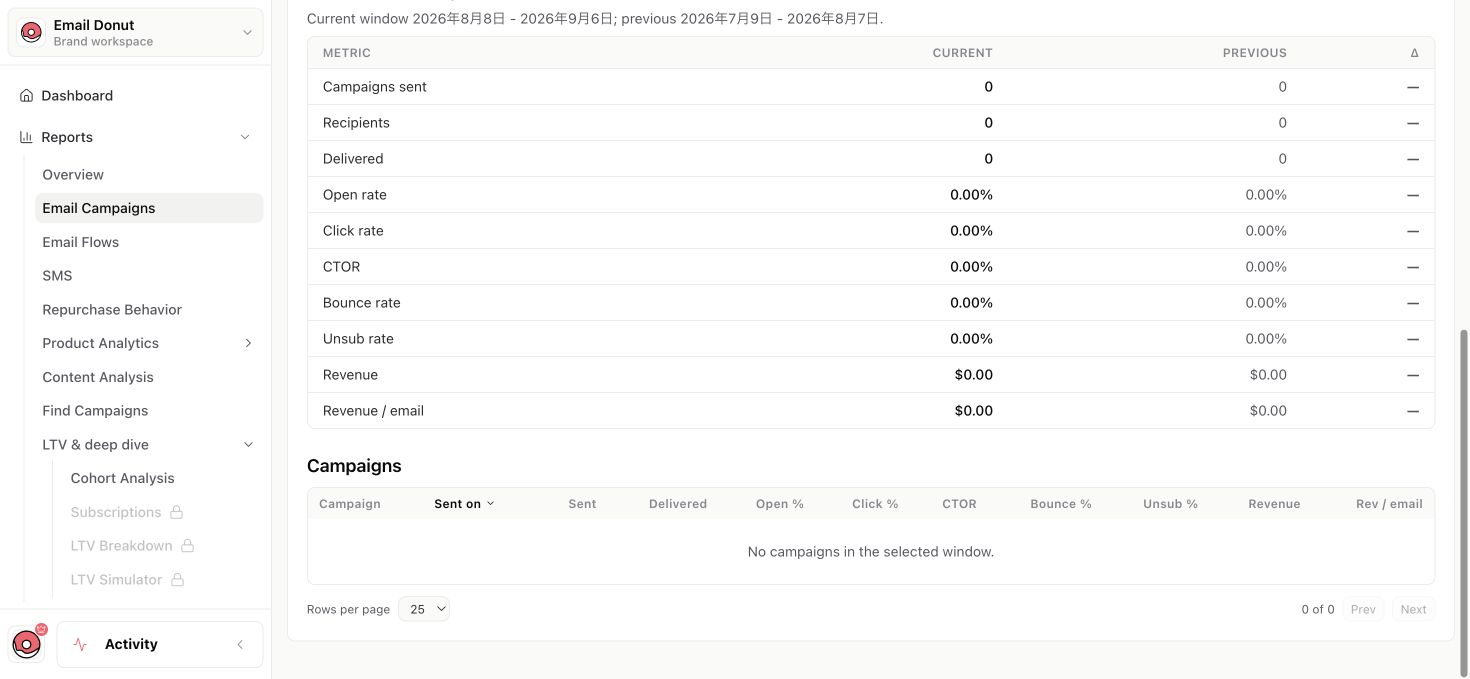
- Campaigns with high revenue and healthy engagement that can inspire another angle.
- Campaigns with strong opens but weak clicks that may need clearer body copy or calls to action.
- Campaigns with high reach and above-normal unsubscribes that may have been too broad or too frequent.
- Outliers that explain most of the change between the two periods.
7. Turn the finding into action
Write down one finding, one hypothesis, and one next action. Examples:
- Finding: Product-education campaigns produced more clicks than discount-only sends. Hypothesis: the audience needed more product context. Action: add an educational campaign to next month's calendar.
- Finding: Open rate increased but click rate decreased. Hypothesis: the subject line promise did not match the email body. Action: align the next subject line, hero message, and primary call to action.
- Finding: Reach is low while engagement remains healthy. Hypothesis: the calendar is not contacting enough of the emailable audience. Action: review cadence and audience selection before adding another send.
Use the Calendar or Generate workspace to apply the decision. Klaviyo history can supply the brand and campaign context, but your team's offer, inventory, launch dates, and business constraints should still guide the final plan.